The most eventful single day of the project
What follows spans one sitting, and I’m splitting it into two posts because there’s too much in it to tell honestly in one. This half covers getting GEM TX working at all. The other half — GEM RX, a UDP console, and a mystery that took until well past midnight to actually crack — is next.
Motivating factor that lead to a lot of complications
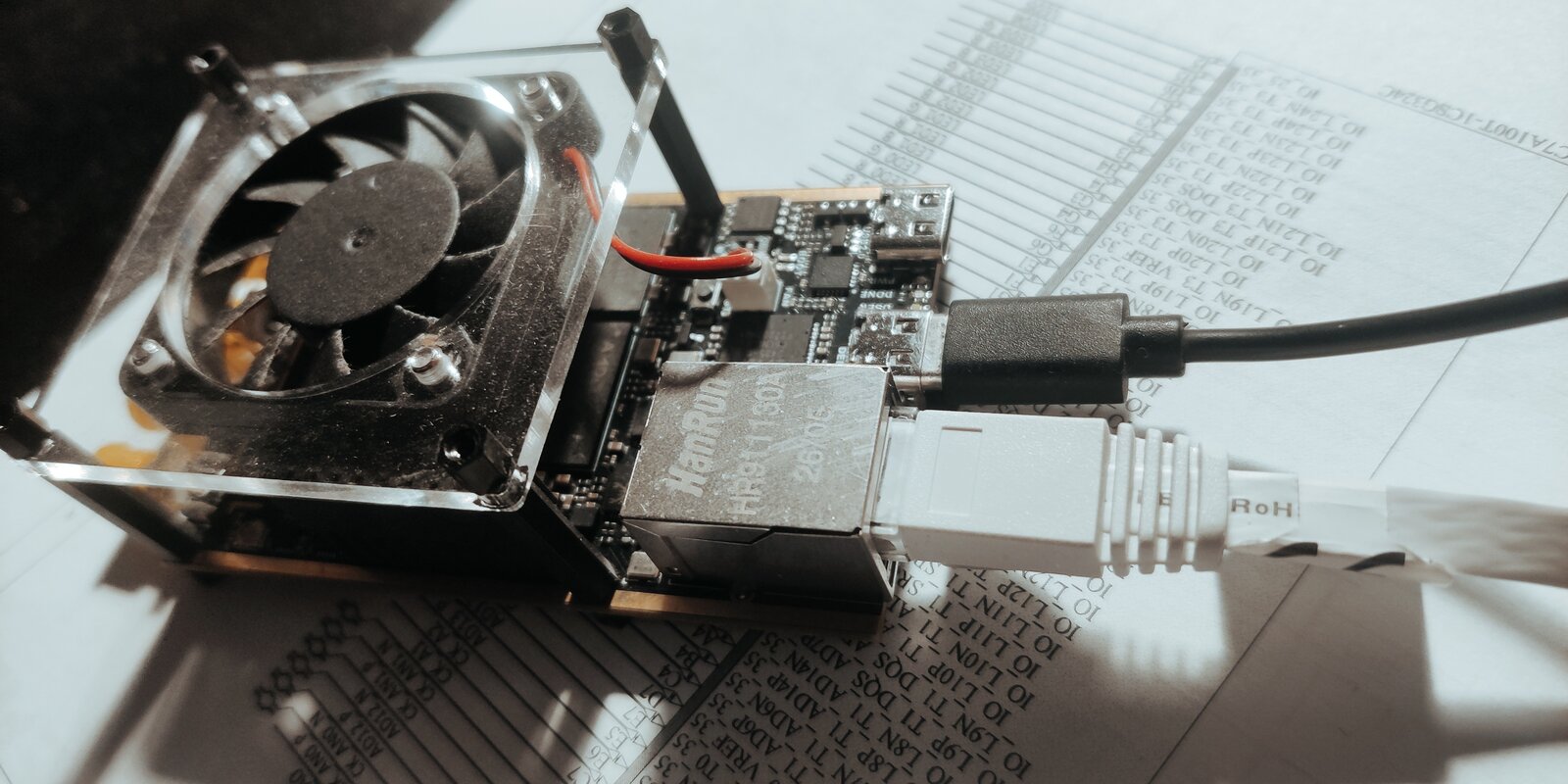
At some point I will want to do something with samples coming out from AD9361. But this device has few GPIO and are hidded behind a fan (that I never bothered to 3d-print new and better). I could use something similar to what I build for the guitar effect months ago with just a load of RTL, but it was just impossible to wire in short time. So the solution was simply sending samples from AD9361 to PL, from PL to PS via AXI DMA, then setting a ring descriptor to send the samples to a PC where I will wire it to the audio card. So we needed to build a TX ring descriptor for this and configure the GEM. That sounds easy…
Six rounds of elimination of a bug
The TXGO bit was getting set and just sitting there stuck, never actually kicking off a transmission via GEM. With datasheet and TRM access at hand I set up a debug plan, not knowing better: a hypothesis grounded in a real TRM citation, implemented, tested on hardware, reported back whether it moved the needle. Five register-level hypotheses got tested and eliminated this way: a live clock-divider glitch, RXQBASE/shared-DMA readiness, DMACR’s endian bit, DMACR’s AHB burst-length field, and — initially — an explicit GEM reset pulse plus a full UG585-documented controller initialization sequence that had been skipped entirely.
On previous experiments, I got a XSDB tool chain up for this kind of diagnostics. Getting that tooling actually working end to end — a batch script for reaching xsdb, and a direct PowerShell serial connection to the board’s COM port, since nothing in the repo already handled that side and together with an open session of Claude Code on this repository, turned the rest of the day from “describe what to test” into “test it directly and report findings.” That shift mattered more than any single register fix that day. And I really came to appreciate an AI agent automatic the debug sessions.
The procedural gotcha that looked exactly like a software bug
Testing the GEM-reset-pulse hypothesis on a genuine power cycle produced a real hang — JTAG’s own stop command timed out, UART went completely silent, and a second attempt left the debug port wedged badly enough that only another power cycle cleared it. The instinct on the AI side was to blame the newly-added reset-pulse code and disable it. That was wrong, and I caught it with plain reasoning rather than more debugging.
The real cause: this board boots entirely via JTAG, with no FSBL and no autonomous flash boot. The FPGA bitstream is volatile SRAM configuration, always lost on power-down, and it had simply never been reprogrammed after either power cycle. Every “successful” test all session had been riding on a PL configuration loaded once, hours earlier, before the debugging even started. Confirmed directly in Vivado’s hardware manager: the device showed as not programmed. Once reprogrammed in the correct order — bitstream, then PS7 init, then application load — the very next test produced a real completed transmission for the first time in the whole investigation, and an independent packet capture confirmed a real frame had actually reached the PC: source 02:00:de:ad:be:ef, broadcast, 142 bytes.
It’s a genuinely useful example of the AI side getting confidently wrong about attribution while still doing everything else right — a different flavor of mistake than a bug in code, and the kind of thing that’s hardest to catch without someone who actually understands the system pushing back on cause rather than symptom.
What “same timestamp” doesn’t actually prove
With one frame confirmed, Wireshark showed something odd: two identical packets per single trigger, same interface, same displayed timestamp. The first instinct was a known, real class of quirk — capture-layer duplication in the Windows packet driver — reasoning that identical timestamps supported it. I pushed back with the same instinct as before, from actually being at the desk:
“The fact that they have the same timestampt makes me think of wireshark duplication (in my case indicated as 5909.102810, hence down to the microsecond, still could see two packets on 40ns period)”
Pulling true per-packet timestamps straight out of the capture file didn’t settle it either, the underlying capture clock turned out to be quantized to whole microseconds regardless of the nanosecond-precision field it reported, so identical timestamps couldn’t distinguish one frame captured twice from two frames genuinely under a microsecond apart. The real answer came from a data source entirely outside the capture pipeline: the Windows NIC driver’s own statistics, checked against a clean idle control first to rule out background traffic. Two isolated trials, +2 frames per single trigger, every time. Real, hardware-confirmed, not a capture artifact.
The actual cause, once I looked it up instead of assuming: the TX ring was a single descriptor with its wrap bit set, pointing back to itself, because it was the only entry that existed. No real driver does this, production TX rings run to dozens or hundreds of entries. I had to find this myself, although there was the indication on the documentation
The funny reason this even happened is that the GEM is free running, once instructed (via TXGO) to send a frame it has the task to unset that bit. Somehow it reads back faster than the unsetting, and it sends the same packet twice, thing that wouldn’t happen if the descriptor ring was bigger than two. So I made it 64 elements and called it good.
Designing for two futures, then handing over the keys
Rebuilding the ring surfaced a real architecture question. The same physical TX ring would eventually need to serve two different producers: a UDP command/reply path replacing the UART console, and a future PL-fed sample-streaming path, with RF sample data only ever flowing board-to-PC and the PC-to-board direction carrying nothing but small command requests. This will get trickier that I thought at the beginning: the PL will have to assemble the whole frame if it wants to write directly into the buffer.
The design we landed on keeps the PL’s job deliberately small: it never assembles a real Ethernet frame, it only ever deposits raw payload bytes into a buffer software already reserved for it. Software still owns every header and still commits the descriptor. The same reserve/commit contract serves a tiny software-built command reply and a hypothetical high-rate PL producer without either one needing special-cased ring code. One more explicit design call from me, with a real justification behind it rather than just convenience:
“There should never be the situation where we fill a buffer faster than it’s discharged… for this application if we can’t stay behind we drop samples… not handling the null is not only cheap, it’s correct for the application.”
A foundational bug, hiding since the first commit
Testing the new ring produced an immediate, different kind of failure: a genuine CPU fault, confirmed via a read-only JTAG halt showing the core parked in Abort mode, disassembly cross-referenced to the exact faulting instruction inside the brand-new ring code. The real cause had nothing to do with the ring: startup.S had never zeroed .bss, a gap that had been latent since the very first version of this project, because nothing before this day’s ring-index variable had ever been a persistent static or global — every prior line of this bare-metal firmware was pure register pokes.
It’s the most foundational bug of the whole session — something every C programmer assumes without thinking about it — sitting there invisible since the project’s first commit, only surfaced by a piece of entirely unrelated new code. A real illustration of coverage as a property of a codebase’s actual history, not just its test suite.
With TX finally solid, the RX side came together fast, right up until it very much didn’t. That’s the second half of this day, next.